



If you're missing one or more teeth, you may have noticed changes not just in your smile, but also in how you chew, speak, or feel overall. It is important to make sure you replace any missing teeth. Missing teeth can impact your confidence and your overall health in ways that often go beyond appearance. That's why it is important to explore reliable, long-term solutions to restore both function and aesthetics. In this video, I'll be talking about dental bridges, what they are, how they work, and how they can effectively replace missing teeth.
What is a dental bridge?
A dental bridge is a fixed restoration, meaning you cannot remove it, that fills in any gaps left by the teeth that you have lost, helping you restore your smile, maintain proper alignment, and improve your ability to eat and speak comfortably. I'll walk you through the process and help you understand whether this option might be right for you.
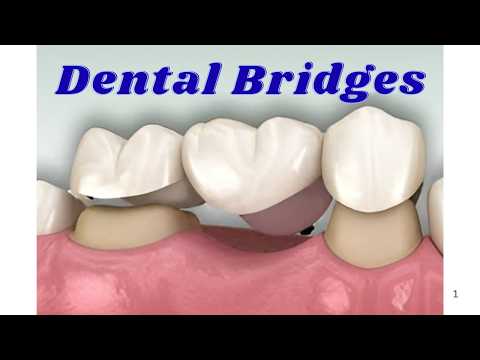
A dental bridge is basically when some teeth need crowns. A dental crown is like a hat that goes over your tooth to reinforce your tooth or replace any missing part of your tooth. A dental bridge, by definition, means you must have a missing tooth in between two adjacent teeth. We basically put a crown on the tooth in front and the tooth behind. But this is not just one crown. It's three crowns together. It comes in one piece. The front tooth holds the front part of the bridge. The back tooth holds the back part of the bridge. The missing tooth is replaced by both teeth in front and behind being the anchors.
What are the benefits and disadvantages of a dental bridge?
The benefit of a dental bridge is basically that it restores your missing tooth with a solution that is not removable. It is stuck and placed in there.
The biggest disadvantage in modern-day dentistry of a dental bridge is that statistically your bridge will fail every eight years. If your crown fails every eight years, you replace the crown, one prosthesis. If your bridge fails every eight years, you have to replace three crowns, three prostheses that are intimately united in one piece.
So it's always three teeth, three teeth, three teeth, and it can be quite expensive. We only do this if someone has an existing bridge already and it needs to be replaced. In modern-day dentistry, we tend to try and stay far away from bridges because it is not the best way to fix a missing tooth any longer. The best way is to put an implant where your tooth was missing to begin with.
What are the alternatives to a dental bridge?
Different alternatives for a bridge, meaning you have a missing tooth: the biggest alternative for a dental bridge is a dental implant. One way is another bridge, and ultimately you can have a removable appliance, a partial denture. These do come in and out. It is cheaper. However, partial dentures are a temporary means, not a permanent solution. They do have other issues that come along with them, such as gum disease and putting torque and pressure on other teeth unnecessarily. So always try and shoot for a dental implant.
What is the difference between fixed and removable options?
Like I was saying, partial dentures are removable. Fixed is something you cannot remove. Most people like fixed. It's a psychological thing that, hey, it's glued in place.
If you’re missing one or more teeth, you may be aware of their importance to your appearance and dental health. Your teeth work together for many daily functions from eating to speaking. With missing teeth, it’s difficult to do these things. Missing teeth can and should be replaced. Fixed bridges are a great way to restore your dental health and appearance.
Fixed bridges are applied by either placing crowns on the abutment teeth or by bonding the artificial teeth directly to the abutment teeth. Fixed bridges are bonded into place and can only be removed by a dental professional. Fixed bridges offer more stability than their removable counterparts.
With removable, there's something in the psyche about having something in your mouth that has to be removed, comes in and out, and it can be embarrassing in certain situations. Removable bridges are attached to the teeth with metal clasps or by precision attachments.
Why is it important to replace a missing tooth?
The most important benefit of a bridge, if we do a bridge, is that it holds the space in between those missing teeth in one position. If you pull a tooth and don't put something there, either a fixed bridge, a removable bridge, or a dental implant, the tooth behind it will tip forward and create a space behind where food gets stuck. The tooth in front of the missing space will drift backward, create a space, and the tooth below it will start to grow up. It really, really messes up your bite. So if you do lose a tooth for whatever reason, you have to replace it. Otherwise, things go terribly wrong from that point on.
How is a dental bridge made and placed?
In modern-day dentistry, if we do have to do a bridge or replace a bridge, we remove the old bridge and remove the cavity. With modern-day technology, such as a CEREC machine, you can scan someone, give it about an hour and a half or so, the bridge is milled, fired in an oven, and glued in place. It may take up to three hours from the time you start until it's over. You have a bridge made, but you leave with your final bridge in place.
How is a dental bridge attached?
The attachment procedure usually takes two or three appointments to complete. At the first appointment Dr. Jacobs will prepare the teeth on either side of the gap by removing a portion of the enamel and dentin.
Since the bridge must be fabricated very precisely to ensure correct bite and to match the opposing tooth, impressions of the teeth are taken and sent to a lab where the bridge will be constructed.
Bridges can be constructed from gold alloys, non-precious alloys, porcelain, or a combination of these materials. Porcelain is often bonded to either precious or non-precious metal.
How long does a dental bridge last?
That bridge lasts, on average, eight years, but it's not the bridge, it's the owner of the bridge, just like the owner of a car. So again, a bridge is dependent on the owner. Make sure you brush, floss, and go see your dentist regularly. It's up to you how long you make your dental bridge last. Average: eight years.
How do you floss and care for a dental bridge?
One of the problems with dental bridges is that you cannot floss normally. You have to have special floss threaders, the little guides that fish underneath the prosthetic or the missing tooth, but you do have to floss in between it where your bridge is flat. Otherwise, you'll get a cavity. Flossing is the hardest thing, but you do need to floss it, even if you have to use threaders that go underneath the missing tooth to clean that out.
Does insurance cover the cost of a dental bridge?
Your dental insurance will indeed cover the cost of a dental bridge. Every policy is different, obviously, and the amount that they will cover varies also, but yes, for the most part, they do tend to cover a certain percentage of your bridge.
How can I schedule a consultation at Riverside Center for Esthetic Dentistry?
Thank you for taking the time to learn a lot more about dental bridge treatment. As we have discussed, dental bridges are a durable and effective way to restore missing teeth, but not the best. They will improve your function and enhance the overall appearance of your smile.
Choosing the right treatment is an important decision, and my goal is to make sure you feel informed and confident every step of the way. If you're dealing with missing teeth or considering your options for something to replace your missing tooth, I encourage you to come in and talk with us. Together, we can determine the best solution for your individual needs and goals.
If you'd like to learn more about dental bridges or schedule a consultation, please call (951) 904-3164 or email [email protected] to learn more. Ready to get started? Schedule your appointment below.