



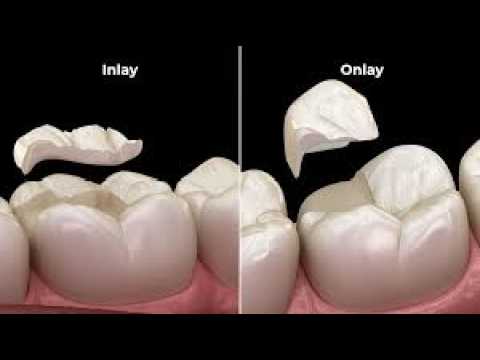
For many patients, hearing that they may need a dental crown can immediately raise concerns, especially when it comes to cost. The good news is that crowns are not the only solution. In some cases, inlays and onlays can provide excellent alternative care for restoring a damaged tooth.
Let's discuss what an inlay and an onlay is, how they work, how they differ from crowns and traditional fillings, and whether they may be a more cost-effective option for certain dental restorations.
What is a dental filling?
If you go to the dentist and he tells you that you have a cavity or a filling already in the tooth that needs to be replaced, often we need to make a decision as to how we're going to replace, fix, or fill that tooth. We can put in what is called a tooth filling. A filling is the most cost-effective way to remove a cavity. However, there are some parameters that we must follow.
In most cases, you need to have more tooth than filling after the filling is done. If you end up with more filling than tooth, often we cannot place a filling because, especially in a molar, it can break. In a molar, you always want more tooth than filling. In premolars, which are more anterior teeth, you still want more tooth than filling. But what is a filling? A filling is basically a plastic material that is made by mankind, and it's chemically united to your tooth. As long as you have more tooth than filling, it'll last you about 5 years.
What if a filling is not an option?
It means you have too much damage to your tooth. Then we put on a crown. A crown differs from a filling in that it is made of different materials. In our office, we use ceramic, which is basically porcelain. It's very natural, very beautiful, and it lasts a long time, often 20 years or more. The important part is that the filling wears over time, whereas the crown does not. Now you can still get a cavity on both.
What if you need a filling but don't want a crown?
With modern-day dentistry, we don't have to put a crown that covers your whole tooth. Often, we just need to remove the cavity and whatever is not good with the tooth. Sometimes we end up with half the tooth. What do we call a porcelain filling that's only for half a tooth? We call it an inlay or an onlay. An inlay fits inside your tooth. An onlay covers part of the chewing surface of the tooth. An inlay fits inside. An onlay fits kind of on top of the tooth.
What are the benefits of getting an inlay or an onlay?
The difference between a filling made out of plastic and an onlay is that an onlay is made out of porcelain, which is a stronger material, or a crown made out of the same portion of the material but it covers all of your tooth.
One of the most important benefits of an inlay or onlay is that you get to preserve your natural tooth. Modern-day dentistry always strives to keep your tooth as much as possible. Every time we do a crown at Riverside Center for Esthetic Dentistry, it is very rare that we cover the entire tooth. Even if we have to cover 80% of the tooth, there is still something we always want to preserve.
In modern-day dentistry, most crowns do not really cover the entire tooth anymore. The benefit of an inlay, an onlay, or a partial crown is that you get to keep a lot more of your tooth. In modern-day dentistry, there is no need to unnecessarily remove tooth structure that is good and functional when we have adhesive dentistry that can just replace what is wrong or broken with your tooth.
What is the procedure for getting an inlay or onlay done to a tooth?
First, Dr. Jacobs will remove the damaged areas (or old fillings) and shape the tooth for the restoration. If you are a candidate for CEREC restoration, an optical 3D image of the tooth surface is taken and the inlay/onlay is constructed using the CEREC system in our office.
After the inlay/onlay is completed, your dentist will check for proper fit and bond the well-fitted onlay or inlay to your tooth with strong resin cement.
Who is a good candidate for an inlay or onlay?
Anybody is a good candidate for an inlay or onlay. If you need a filling, you can choose to have a porcelain filling, which is an inlay. If you need a crown, you can choose to have an onlay, which is a partial crown. Keep in mind, though, for the most part, the cost tends to be the same between inlays, onlays, and crowns.
Sometimes we charge a little bit more for an inlay and onlay. You may ask why, because it's only half a crown. Yes, even though it is half a crown, it is actually twice as hard because we have to prepare different angulations and it is much harder to do an inlay or an onlay versus a crown. Keep in mind that cost is not always a savings, but anything we can do to save your tooth we are always for it. Because they're porcelain, inlays and onlays will keep going, meaning the material does not break down over time.
However, any restoration, not that the ceramic gets a cavity, but your tooth that supports the ceramic can get a cavity forcing us to replace your inlay, onlay, or crown. Keep that in mind. You must always maintain good oral health. Brush, floss, and go see your dentist regularly. Something that's interesting nowadays is that modern-day ceramics can in fact be repaired. If you do get a cavity, maybe we can just put a filling next to your modern-day ceramic crown and repair it that way instead of having to remove your entire restoration.
Will dental insurance cover inlays or onlays?
A funny thing about dental insurance is that they do cover crowns, fillings, and partial crowns like 3/4 crowns, but the minute you say you're doing an onlay, they look at that as if you're just getting a fancy filling. They tend to pay just for the filling. The cost difference often rests on the patient. The insurance company doesn't care what material you choose. It is your choice. Your dental insurance will only reimburse you up to the filling cost, and the difference would be your responsibility. There are no real issues that arise from getting an onlay or inlay, only good things are benefits, right? You get to keep your tooth.
Again, whoever does your crown needs to know what they're doing for your inlay or onlay. They need to be very good at modern-day dentistry, which is most of the dentists out there. Being really good at this can be an excellent option for restoring teeth that are too damaged for traditional fillings, but may not require a full crown. They help strengthen and protect the natural tooth while preserving more of its original tooth structure.
If you've been told you may need a crown, it's always worth asking your dentist whether an inlay or onlay might be an appropriate alternative for your situation. Every case is different, and the best treatment will depend on the condition of the tooth and your overall dental health.
Expert Dental Care at Riverside Center for Esthetic Dentistry
Your dental health matters to us, and we’re here to support you every step of the way. If you’re looking for expert dental care near Riverside, CA, call (951) 904-3164 or email [email protected] to learn more. Ready to get started? Schedule your appointment below.